
It's big out there
On being and creating in public despite, well, EVERYthing
![Olivia [Iannone] Collins's avatar](https://substackcdn.com/image/fetch/$s_!Lswg!,w_108,h_108,c_fill,f_webp,q_auto:good,fl_progressive:steep/https%3A%2F%2Fsubstack-post-media.s3.amazonaws.com%2Fpublic%2Fimages%2F5bc91c83-b3a0-4589-8b6d-82903023fcc6_1364x1364.jpeg)
I’m writing this piece for me, because sometimes that’s the only way I can trick myself into saying anything in a world that’s already so loud.
But I hope it’s for you, too, because I’m willing to bet I’m not the only one out here who freezes up and backs down every time an idea half-forms in her head.
Maybe you shy away from making anything, because everything has already been made. Shy away from doing anything, because someone else out there has already done it better. Shy away from being anyone, especially in public, because having a personality has become a business model.
You know this is all true because you’ve seen it. You see everything, actually. Whether you like it or not. All at once.
I don’t know anything about this place.
A month ago, I took a journey with a dear friend through southern Utah, a region which I love profoundly and yet know next to nothing about.
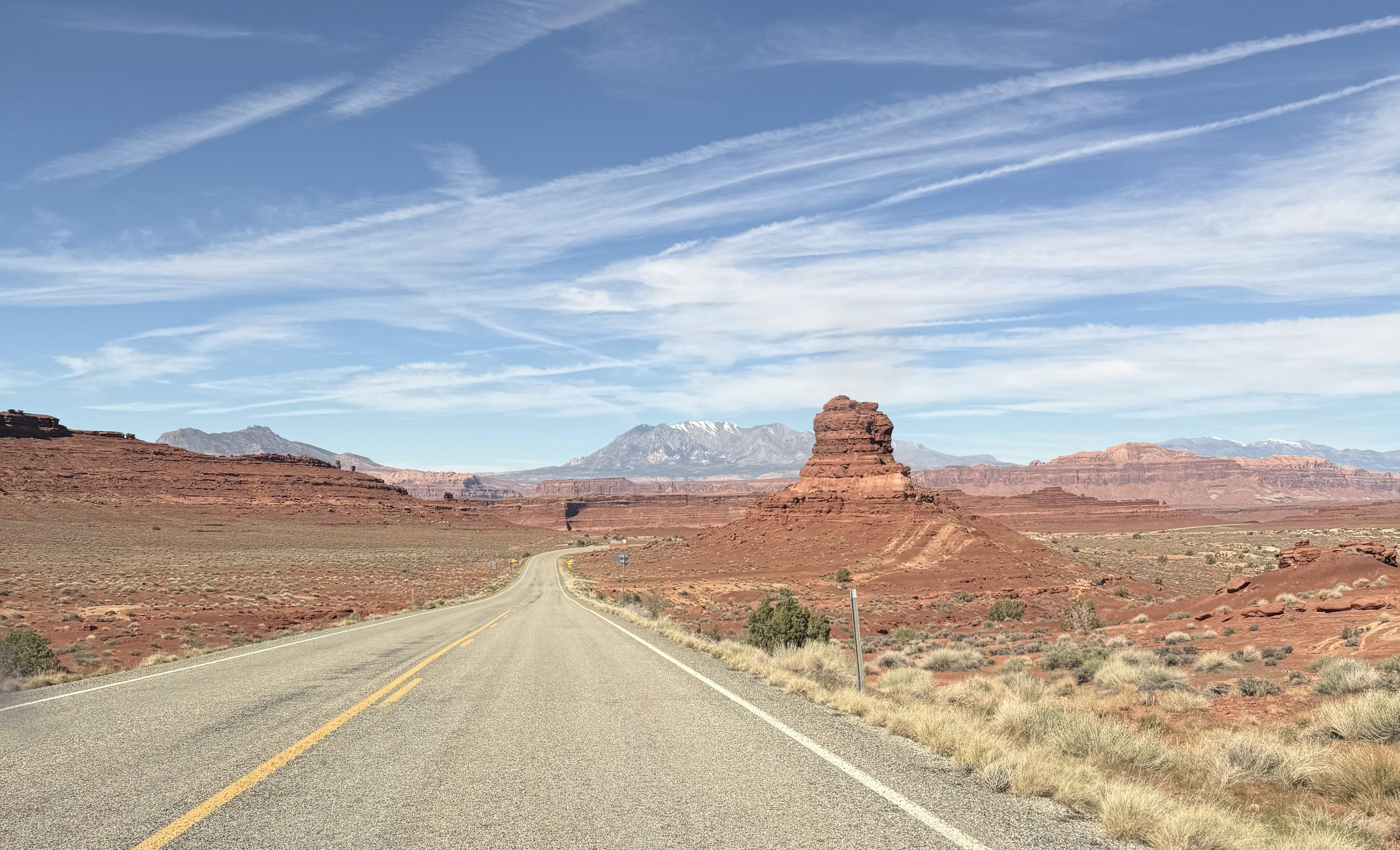
Actually, a correction: I love southern Utah largely because I know so little about it.
When you drive through southern Utah, you can’t help but say: It’s BIG out here. Two-lane highways cut wide arcs around tall red buttes, then crumbling grey mesas, then giant soft-serve cones of windswept beige sandstone. The highways guide you gradually up, up, up and then down, down, down through hundreds of feet of rock and millions of years of geologic time.
You whiz past pictographs you will never see, canyons you will never descend, fossils that will turn to dust before any human pries them from the sediment.
Eventually, after hours of driving (maybe even a few extra hours, if you, ahem, forget to get gas and, idk I’m just spitballing here, have to double back to Hanksville) you arrive at some trailhead to descend some canyon. It’s almost certainly not the most perfect trail; the most perfect canyon. But you knew about this trailhead, this canyon, and you came here on purpose. Now, the depths are calling to you.
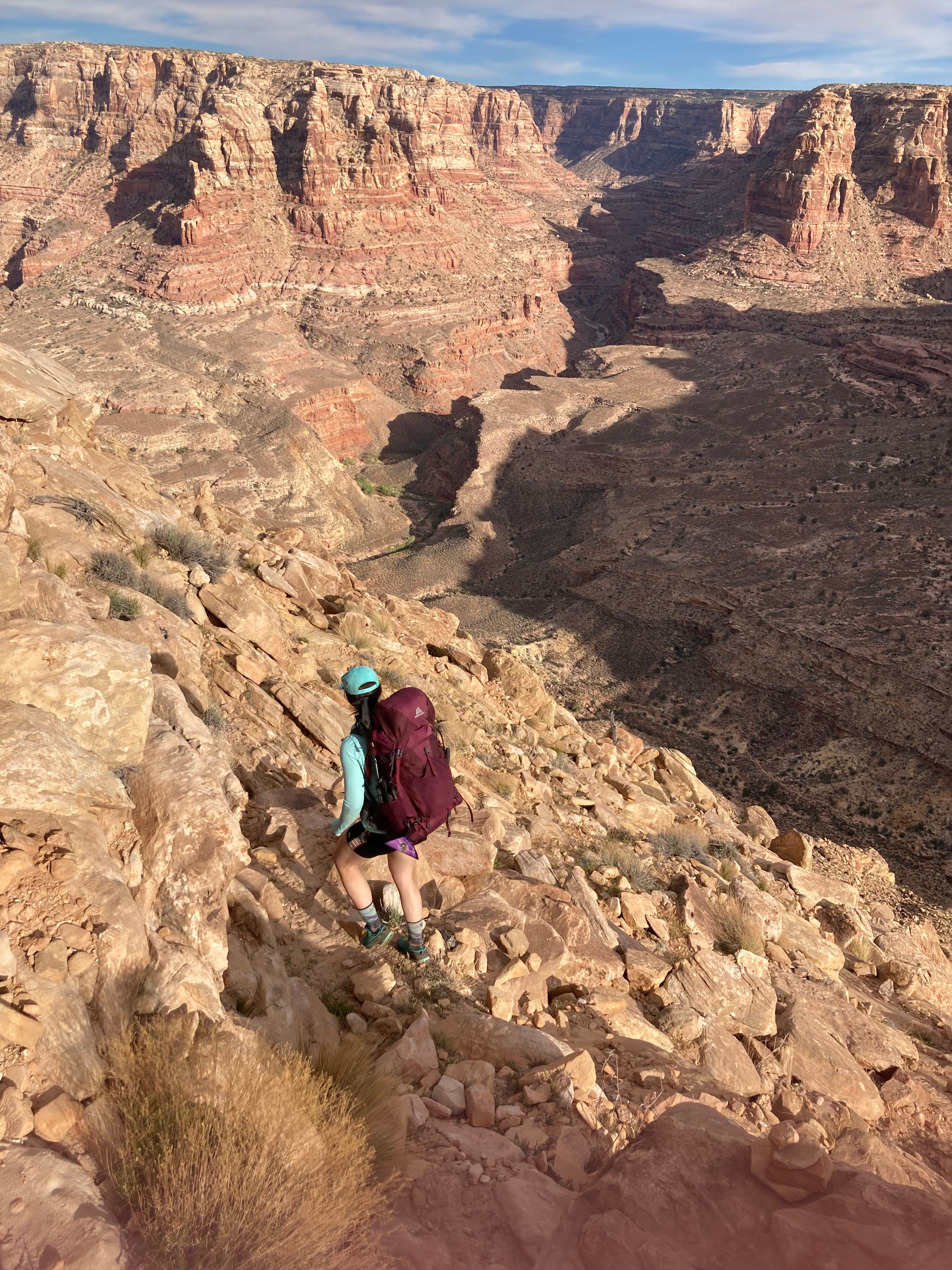
So.
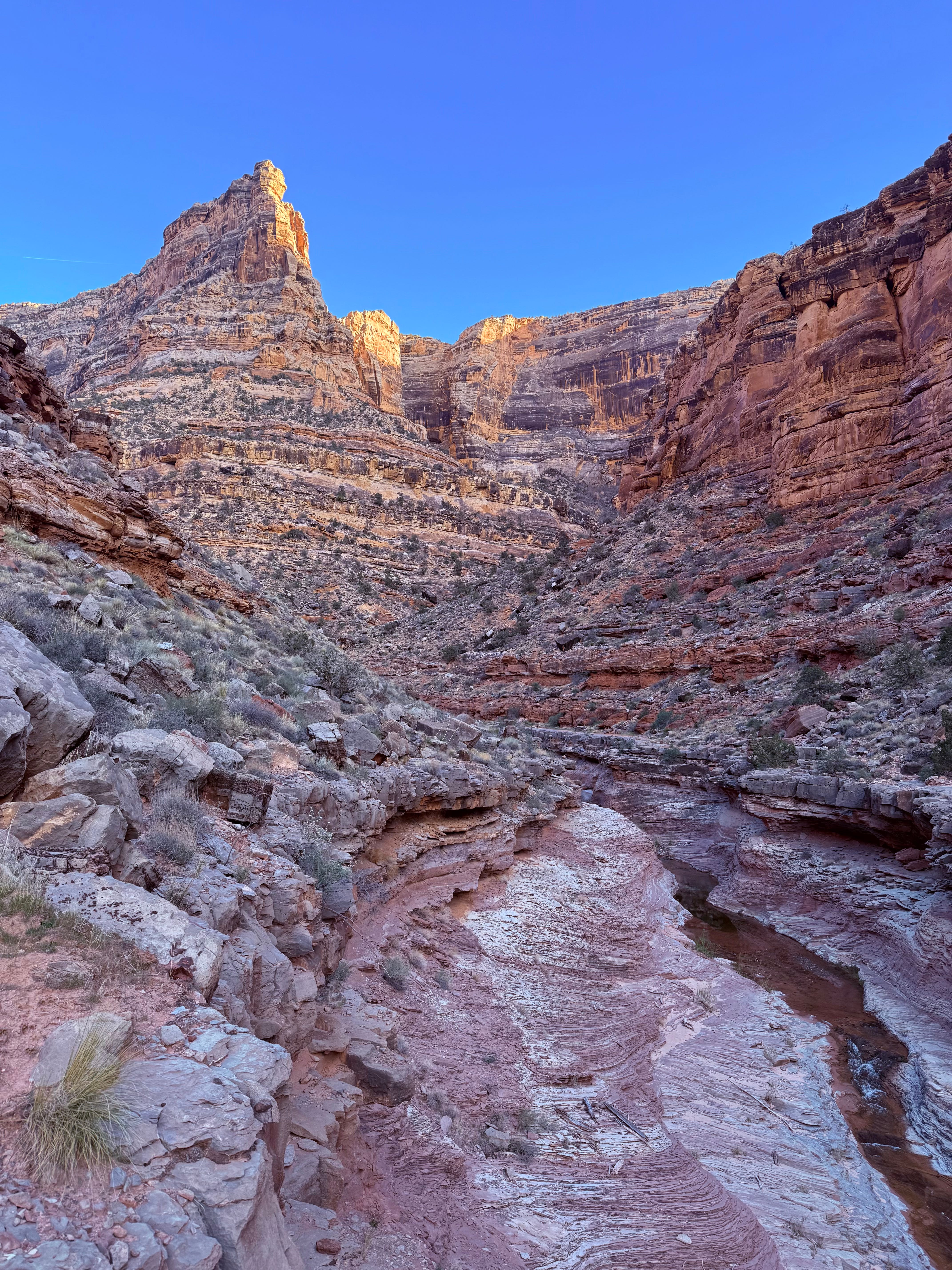
You descend and you discover, perhaps, that the river is clearer than you expected but the waterfall less impressive. You spend less time cruising over firm rock and more time trudging through sand.
On the second day, the hike is longer than it looked on the map so you walk the last two miles in the dark alongside many Night Creatures (frogs sing; your friend catches a nighthawk in her headlamp beam; a confused bat almost bonks you in the face).
On the third day, when you emerge from this one pocket of this vast pocketed landscape, it is with a deeper knowing and love for said pocket. On high ground once again, you can see how much the land folds into unknowable depths. It’s obvious that there are dozens, hundreds of canyons and trails out there. Each is just like yours, but entirely different.
What I find interesting about all this is: none of this knowledge makes your trail down your canyon feel any less worthy. It doesn’t make the time you invested feel any less valuable. If anything, it makes it more so.
Because you, as your individual self, have spent time engaging deeply with one individual place. And the rest of it is unknowable and none of your concern and that is part of the charm of it all.
And for my next trick I shall turn the beautiful desert into an Internet Hellscape metaphor I’m so sorry.
Now. Imagine, as you were flying down the road through the red-rock desert, you could see a live feed down every trail, into every canyon, over every ridge. That you could compare the beauty of each shaded cottonwood grove and the athletic prowess of every human adventurer. That you felt a tremendous pressure to choose the most epic hike, and they were all within reach because you could teleport yourself instantly to any trailhead.
Not only are you not having fun, you’ve already gone insane. You went insane before you even left home. In fact: you’re still at home, not knowing why your pure-hearted desire to enjoy the beauty of nature has spiraled out into existential dread.
There are many reasons the outdoors appeal to so many of us. I’d argue that this is one. We interact with the outdoors the way our brains were designed to interact with everything. That is: in a way that’s deeply present. The stimuli coming at us and the choices presented to us are limited by geography. The very physicality of being outdoors means that even thought we do have apps and websites to point us to places, we can’t hop between them like browser tabs.
But time in nature is just ONE of the many nutrients your human soul needs.
Self-expression, storytelling, creativity, community. All of these are necessary to our humanity. But because they translate more easily to a digital spaces, engaging with them deeply and intentionally has become hard. Like: not only CAN you hop between voices and pieces of art and communities by way of browser tabs — the new paradigm expects you to. There are perks that come with this model, sure, but speaking for myself, it has one particular effect that is very very strong. And that is the following:
I am overstimulated.
When I am overstimulated, I don’t do anything.
I don’t write. I don’t engage with my own thoughts or my own story. I don’t share my opinion. I don’t reach out.
This is a sucky place to be. It leaves your soul a little anemic. You can try and over-compensate with time in nature and physical exercise or whatever other activities still feel pure (ahem, long trips through southern Utah), but you can’t just leave out all the other essentials that have become scary in their digital vastness.
How to cope?
When I’m overstimulated, I find its helpful to have a playbook. Touchstone thoughts and simple actions. Here’s what’s working for me, at least somewhat, at least right now.
An experimental playbook for being & creating when it feels pointless
“Some say the creative life is in ideas, some say it is in doing. It seems in most instances to be in a simple being … It is the love of something, having so much love for something — whether a person, a word, an image, an idea, the land, or humanity — that all that can be done with the overflow is to create.”
-Clarisa Pinkola Estés | Women Who Run With the Wolves
NOTE: How Dr. Estés puts it above really resonates with me. “Creation” isn’t a particular activity, but an act of being, consciously, in the world. From now on, when I talk about “creating,” or specifically writing, feel free to apply what I’m saying to whatever you want.
1 - Remember that you’re just overstimulated. THAT’S ALL.
If you’re like me, you may have a talent for building grandiose stories around physical and emotional experiences that are actually dumb-simple.
For example: I have learned that “the email I just received is really annoying and oh god my house is so messy and I don’t even want to go to that party this weekend why did I say yes and ugh I’m falling behind making dinner” translates, roughly, to “I’m hungry.”
There are also a ton of stories I tell myself about creating anything in the digital age:
“You’re not even that good at art/writing/having an opinion. You’re not qualified. You’re not educated. You don’t cite enough sources. Therefore you cannot, must not.”
“There is so much of this thing out there, the world doesn’t need you to produce MORE.”
“If attention is currency, and you don’t want to opt into that particular economy, you might as well keep everything you make/do/say in a dusty box under your bed.”
When I realize that literally ALL THESE are elaborate translations of “I am overstimulated,” the big scary facade breaks down. Now I can focus on strategies to move through the overstimulation…
2 - Create what you enjoy creating
“If You Have Writer’s Block, Maybe You Should Stop Lying”
—Sasha Chapin wrote a whole essay on this that you should read… the quote above is only the title.
Make what you ENJOY making. Do what you ENJOY doing. This should be obvious, but it’s not.
“Enjoyment” is SUCH an important concept that often gets muddled, especially when we talk about creativity, because, yeah, the process of creation does come with some discomfort.
But have you ever heard a fitness coach or yoga teacher or massage therapist talk about the difference between “good pain” and “bad pain"?” The former being the pain of growing or healing; the latter being the pain of actually damaging yourself?
Its the same with mental/psychic exertion as it is with the physical. You can FEEL the difference. Especially when you get to the other side and you’re looking back on the discomfort you just pushed through. You know what you’re working on is right if the majority of the time you look back and say: yeah, that was hard as heck, and I like that I did it.
People started telling me I was a ~good writer~ when I was about six years old. I think you can imagine how this went sideways: a little bit of gifted-child mindfuckery; many years of having to sledge-hammer my thoughts into five-paragraph-essay shaped boxes.
Along the way, I forgot what it feels like to enjoy writing. Or to write when I enjoy. Actually, both. In the process of chaotically intuitively re-learning, I’ve broken down enjoyment into two buckets:
2a - Write what feels fun.
My last post on here was a tiny little story about a dirty motel that could’ve been a journal entry.
After jotting down the outline, I thought about filing it away in a folder called Orphan Anecdotes, so that I could maybe someday pull it into a memoir to add some color.
But will I ever write a memoir? Hell, the road to my current reality is paved in Orphan Anecdotes. I don’t need MORE. Why not flesh this story now, and pop it on Substack while it felt FUN?
Why not practice making things and putting them somewhere visible and public?
2b - Write what feels important.
So this is actually much harder and I will readily admit that I basically don’t know how to do this this is my main Growth Area when it comes to the writing practice!
“Writing what feels important” requires that we know what feels important to us, specifically, in this incredibly noisy world. As if that wasn’t hard enough, it then requires us to engage with what feels important to us for a period of hours, without talking ourselves out of it halfway through.
To kick things up a notch, we must challenge ourselves to share said exploration of what is important to us, which exposes us to a range of dangers:
The danger of finding out we are “not that deep”
The danger of making no sense, or of being misunderstood
By extension, the dangers of rejection, isolation, or ridicule
The whole exercise requires self-esteem, or it requires courage, or it requires faith, or it requires love for oneself and one’s ideas and society. Maybe all of the above.
(THIS, by the way, is why writers like to write about writing. We have discovered that to write is just to be human. And figuring out how to be human is, like, the entire Assignment.)
So, yeah. Writing what feels important is scary! But I think the key piece here is the word “feels.”
Don’t try to find out what is important, on the grand scale. Instead, focus alllll the way inward on what feels important, to YOU. After all, “important” is subjective.
To pin this idea down, I like to think about the pieces of writing that hook me in and inspire me as I stumble around the internet. Almost always, they are very specific, very personal. They are tiny windows into moments in ordinary people’s lives that unexpectedly mirror mine. Or invitations to peek through the lens of a strong principle that I don’t personally hold.
We are all social, intimate creatures. No one’s out there looking for HomeGoods throw pillow quotes or a regurgitation of the recent opinions of the NY Times editorial board.
The very specific thing that feels important for YOU to say is, guaranteed, the very specific thing SOMEONE needs to hear. That person may never encounter your work, but the fact that they exist or existed or will exist is, I think, more than enough to justify what you are creating.
3 - Don’t hide behind “permission to be bad at things”
Recently I took a pottery class. I went into it fully expecting to be bad at pottery. I was even looking forward to being bad at pottery. Guess what? I was bad at pottery. And I had a great time.
There’s something to be said about giving yourself a creative space to be “bad” at whatever it is your doing. Because sometimes, the weight of the expectation to be “good” at things is absolutely paralyzing. (Hello, school system! Hello, internalized capitalism!) When we pivot to a discipline where that pressure doesn’t exist, we remind ourselves that creativity is allowed to be fun and joyful.
But I would argue this pendulum can swing TOO far. To the point where we give ourselves an excuse to never actually try hard at all. And maybe the fear that stands between us and the discipline at which we are talented isn’t some kind of trauma that needs coddling — it’s just the vulnerability that comes with caring about things.
If that’s the case, the only way out is through. You have to do it scared. Being creative isn’t JUST about joy and fun. It’s also not JUST about getting out of your comfort zone. Is has to be both. You have to find both.
4- Be really freaking proud of the parts of you the robots can’t impersonate.
Y’all, it’s an AI slopfest out there. You are probably feeling a bit of righteous rage. Hell, I’m pissed off at the fact that I have to write about it — and I do, I’d be remiss not to.
Now. I’m not going to tell you that you should, per se, let yourself be fueled by righteous rage. (Though: if that strategy works for you, by all means, go off, queen.)
Instead, let’s move over a few ticks on the emotional color wheel. Let’s drop the rage and fuel ourselves with pure self-righteousness. Let’s saddle up our high-horses and ride.
“Ok,” you say as you pull up alongside me in our magnificent high-horse cavalry. “What are we so proud about?”
We are proud — we MUST be proud — of the things that make us human.
It’s become increasingly clear that there are certain cognitive tasks machines are really, really good at. But there’s a reason why the Claudes and Geminis of the world, for all the impressiveness of their resumes, are still mostly stumbling around in the Uncanny Valley. The human experience is just too darn squishy.
AI is bad at the things we can feel but can never 100% put into words. And, lucky us! That’s exactly what ART is about!
I love this recent piece by Adam Mastroianni — few things give me the warm fuzzies quite so much as curling up with a well-thought-out argument written by someone smarter than me about why the robots won’t win.
Essentially, he helps draw a line between the different types of intelligence our human brains possess: the kind AI can simulate, and the kind it can’t.
When it comes to the craft of writing — which, obviously, AI is doing a LOT of these days — the difference is, again, something we mostly FEEL. Machine-written content can be logical, and it can engage with emotion on a superficial level. But when it tries to create a good metaphor or a new joke or (especially!) a lyrical turn of phrase, it falls flat. When you’re speed-reading AI-generated content, you might not notice, but it breaks down under scrutiny.
Human-written content, Adam argues, contains bits that are objectively nonsense to a computer, but they make you and I feel things. Case in point, straight from the essay:
“It’s hard to describe exactly what the machines are missing. Have you ever loved someone who once loved you back, then didn’t anymore? Did you notice how their eyes dimmed? Did you note the disappearance of that subtle wrinkle in the temples that distinguishes a real smile from a fake one? Did you catch it when you stopped being cared for and started being humored? The moment you realize what’s happening, you age out of your enchantment—one day you’re crawling through a wardrobe to Narnia, and next day you open up the wardrobe and there’s nothing but hangers. Talking to an AI feels a bit like that, except without the nice part at the beginning.”
We, as humans, still have a secret code. Sink your teeth into this concept and don’t let go.
Create things. Follow your feelings down weird bunny trails. Bridge the gap between logic and squishiness. There, you are powerful.
5- Once you’re focused, stay there as long as you can
By now, if all goes well, you will have tricked yourself into descending to a place where you’re fully engaged with the one thing you are writing or reading or doing or making.
Safely contained in the walls of your own mind, you lay down your burden on a soft patch of ground and make a temporary home for yourself.
You discover, perhaps, that a particular well of inspiration has run dry, but that a secret spur trail leads to a sweeping perspective you never considered before.
It takes effort to get here, so it’s important that you stay as long as you need to. Engage with what you are drawn to, make what you need to make, say what you need to say.
When you emerge, after hours or days, and look out again at the terrifying vastness of the information age, you’ll hopefully feel a little more grounded. Because in spite of all the forces stacked against you, you have engaged deeply and intentionally with your own humanity.
You will understand (even if just for a moment) that trying to wrap your arms around everything else at once is actually not your job and that you are free after all.